Artificial intelligence is everywhere: writing drafts, summarizing meetings, suggesting how to phrase an email. That ubiquity sparks a fair question: Does AI make us less human?
We acknowledge that AI carries real harms like bias, misinformation, over-automation, and privacy risks. But used thoughtfully, AI can actually make us more human by freeing time for creative work, sharpening strategic thinking, and expanding access to knowledge and opportunity.
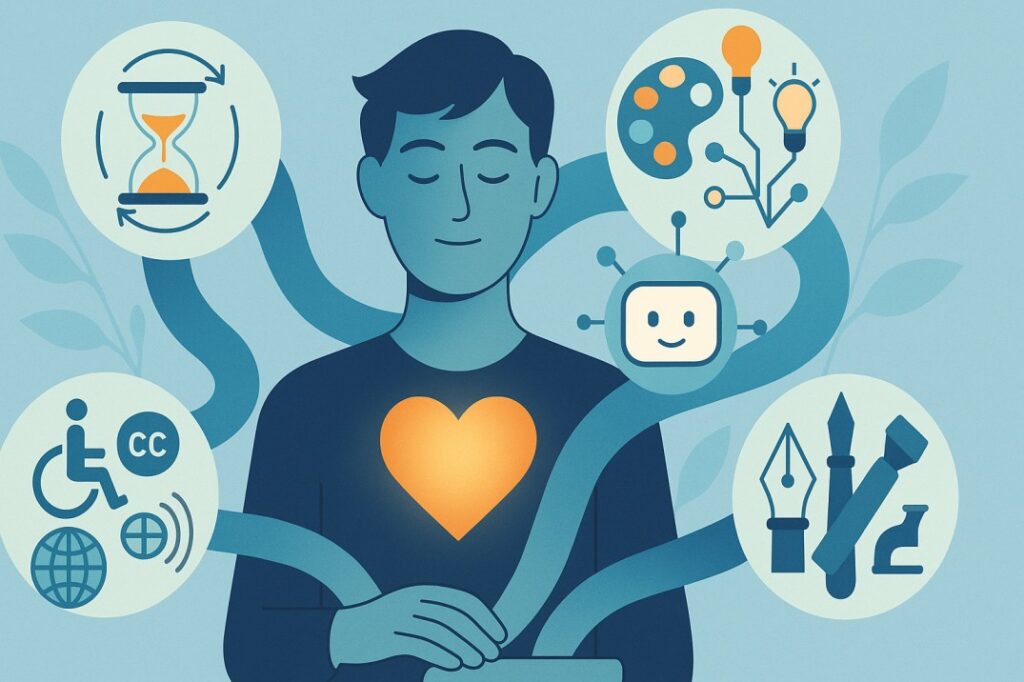
1) Automation gives us back what matters most: time
AI excels at repetitive, time-hungry tasks: transcribing calls, categorizing support tickets, surfacing data from long documents, and drafting first-pass content. Offloading these chores can reclaim hours for:
- Creative processes: brainstorming campaigns, sketching product ideas, composing music, storyboarding videos.
- Strategic tasks: market analysis, scenario planning, prioritization, stakeholder alignment.
- Relationship work: coaching teammates, meeting customers, connecting with communities.
The goal isn’t to do more low-value tasks faster; it’s to do fewer trivial things so we can do more meaningful things—the essence of becoming more human at work and in life.
2) AI as a creativity catalyst—not a creativity crutch
When used as a collaborator, AI can expand the creative frontier:
- Idea generation: Ask for 20 off-beat angles you wouldn’t have considered.
- Constraint play: “Rewrite this concept for a 10-second spot” or “Explain this to a 7-year-old.”
- Style exploration: Test voices, formats, and structures to spark new directions.
The trick is to keep human judgment at the center. Let AI widen the search space, then use your taste, values, and context to pick and polish the winners. That’s co-creation, not outsourcing.
3) Accessibility that amplifies participation
AI can remove barriers that hold people back:
- Real-time transcription and translation improve meetings and content for global or hearing-impaired audiences.
- Reading aids and summarizers help neurodiverse users process complex texts.
- Voice interfaces unlock tasks for people who can’t type or see screens easily.
More voices at the table means richer ideas and more human outcomes.
4) From busywork to craftsmanship
The more work we automate responsibly, the more we can practice distinctly human crafts:
- Writing that sounds like you, not a template.
- Product sense shaped by real user stories, not just dashboards.
- Leadership that mentors, negotiates, and inspires—things no model can authentically replace.
Automation isn’t the destination; craft is.
Practical steps to use AI wisely—today
- Define “human-in-the-loop” moments. Decide which decisions require human review and why.
- Create an AI style guide. Tone, accuracy standards, citation rules, and when to avoid AI altogether.
- Instrument for learning. Track what AI helps with, what it breaks, and where it saves meaningful time.
- Run reviews. Periodically test prompts and policies for bias, leakage, or misuse.
- Invest in skills. Teach prompt craft, critical reading, and data literacy. Tools change; thinking scales.
- Start with low-risk, high-value use cases. Summaries, drafts, research scaffolding, then expand thoughtfully.
Die Quintessenz
AI isn’t inherently dehumanizing or humanizing; rather, it’s amplifying. If we let it absorb the routine and the manual, we gain space for imagination, strategy, empathy, and craft. If we ignore its risks, we risk scaling our worst habits. Used with intention and wisdom, AI can help us do what only humans can: create meaning, make wise decisions, and build a more humane future.
Read more on AI and Agentic AI:
Whitepaper: Agentic AI at ProcessMaker
Agentische KI in der Prozessautomatisierung
Organisatorische Bereitschaft für agentenbasierte KI
Ethische Überlegungen zur agentenbasierten KI
Hindernisse für die Einführung von KI in der Geschäftsprozessautomatisierung
Making AI Inclusive for Non-Technical Teams
Das volle Potenzial von KI ausschöpfen: Warum Task Mining Ihre Geheimwaffe ist
The Perfect Partnership of BPA and AI
The Rise of AI Whisperers: Bridging the Gap Between AI and Business
Use cases:
5 Wege, wie Agenten-KI Mitarbeitererfahrungen transformiert
Automatisierung in der Investmentanalyse: Wie agentenbasierte KI die Branche verändert